How Spotify and FC Barcelona turned a football sponsorship into one of the most sophisticated cultural marketing platforms in modern entertainment.
Football and music were always connected
Football and music have always belonged together. Long before Spotify existed, football clubs and music scenes were already deeply intertwined, particularly in Britain. Oasis became inseparable from Manchester City. The Stone Roses helped shape the emotional atmosphere surrounding football culture in the 1990s. Bands like Arctic Monkeys or The Libertines emerged from the same urban identities, working-class environments and collective rituals that also defined football fandom.
What has changed is not the relationship itself, but the infrastructure surrounding it. Streaming platforms, social media and data now allow companies to industrialise cultural moments at a global scale, transforming what was once an organic crossover into something measurable, programmable and globally amplified. Perhaps no partnership illustrates this shift better than Spotify and FC Barcelona.
The Olivia Rodrigo activation
This weekend, Barça defeated Real Madrid and celebrated another La Liga title. But while millions watched El Clásico unfold on the pitch, another kind of victory was taking place in parallel: the battle for global attention. What happened with Olivia Rodrigo, Spotify and Barça was not simply a sponsorship activation. It was a sophisticated case study in how entertainment, fandom, data and sport are increasingly converging into a single ecosystem.
Days before the match, Olivia Rodrigo performed a secret concert at Barcelona’s Teatre Grec. The tickets were never publicly sold. Instead, Spotify identified the artist’s top listeners in Barcelona through actual listening behaviour and engagement data, then invited them to attend for free. That detail matters because, at a time when live music has become increasingly expensive and inaccessible for younger audiences, Spotify offered something almost impossible to buy: intimacy and access. Not access to a stadium concert with tens of thousands of people, but access to an exclusive cultural moment designed specifically for the artist’s most engaged fans.

The hidden location, the secrecy surrounding the event and Olivia Rodrigo’s own appearance at El Clásico were not random creative decisions. They were carefully designed mechanisms for cultural amplification. Spotify understood that the people attending the concert would not simply consume the campaign; they would become its distribution channel.
From sponsorship to cultural infrastructure
For decades, sponsorship operated through visibility. A brand paid to place its logo on a jersey, around a stadium or during a television broadcast. Exposure itself was the product. But visibility alone no longer guarantees relevance.
In today’s attention economy, brands compete not only against one another, but against every platform, creator and entertainment experience fighting for emotional space in people’s lives. Football clubs are no longer competing solely with rival teams; they are competing with Netflix, TikTok, Disney, Twitch, YouTube creators and music festivals.
Spotify and Barça appear to understand this transformation better than almost anyone. Their collaboration no longer behaves like a traditional sponsorship. It functions more like a cultural platform where football, music, internet culture and fandom merge into a single narrative ecosystem. Even the Barça jersey stops functioning as mere advertising space and becomes a cultural object in its own right.
The strategy also works because it operates simultaneously at multiple emotional levels. For football fans, the campaign enhances the symbolic magnitude of El Clásico. For music fans, it transforms an artist into part of a global sporting spectacle. And for digital audiences, it creates the kind of internet-native moment designed to travel organically across TikTok, Instagram and fan communities.
This is not just branding. It is cultural engineering.
The Rosalía effect and measurable impact
The clearest evidence that the model works may have arrived through Rosalía. After her collaboration with Spotify and Barça, Billboard reported substantial increases in streaming activity across several international markets. Her streams reportedly increased by around 220% in Egypt, roughly 170% in Morocco and nearly 70% in Nigeria. Sponsorship analytics company Blinkfire also reported engagement levels significantly above the club’s typical commercial benchmarks during several Barça-Spotify activations, reinforcing the idea that these collaborations function less like traditional sponsorships and more like globally amplified entertainment events.
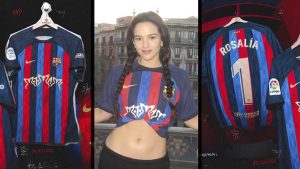
Those figures are remarkable not simply because they are large, but because they reveal the strategic depth behind the partnership.
These were not necessarily core Rosalía markets beforehand. El Clásico effectively became a global music discovery engine capable of introducing artists to entirely new audiences through football culture.
That may be the real genius behind Spotify’s approach. The company is not using football merely to advertise artists; it is using football as infrastructure for cultural distribution. Unlike traditional advertising, fandom creates voluntary attention.
People did not share the Olivia Rodrigo campaign because they were targeted by media buying. They shared it because participation itself became socially valuable. Fans documented the concert, the secrecy, the exclusivity and the emotional significance of having been selected through their listening habits.
Spotify transformed data into belonging, using first-party behavioural data not only to personalise recommendations, but to build emotional exclusivity and cultural participation around the artist experience itself. That is a very different proposition from conventional sponsorship.
The future of football brands
This partnership also reveals something important about the future of football clubs themselves. Historically, clubs primarily understood themselves as sporting institutions. But the most influential clubs of the next decade will likely function as something much broader: cultural companies.
Football will remain the centre of gravity, but orbiting around it will be music, fashion, creators, documentaries, gaming, live experiences and digital storytelling. The clubs capable of orchestrating these worlds coherently will not simply win matches; they will dominate cultural relevance.
In many ways, Barça and Spotify are already prototyping that future.
And perhaps that is why this collaboration feels so significant beyond sport itself. It offers a blueprint not only for football, but for the wider entertainment industry trying to understand how attention, identity and fandom now operate.
People no longer consume sport, music and entertainment separately. They experience them simultaneously, often within the same platforms, conversations and digital behaviours.
The companies capable of creating shared cultural moments across these worlds will shape the next era of global attention.
Barça may have won La Liga, but Spotify demonstrated something potentially even more important: the future of sponsorship is no longer about visibility alone. It is about becoming part of culture.
Beyond global stars: football clubs as cultural amplifiers
There is also a broader cultural opportunity emerging from all of this, and perhaps it is the most interesting one for the future. If football clubs are becoming cultural platforms with the ability to generate massive global attention, then their role should not be limited exclusively to amplifying already established global superstars. The same infrastructure capable of turning an artist into a worldwide cultural conversation could also be used to support emerging creators, local scenes, independent projects and cultural expressions that rarely have access to this level of visibility.
That is where the real transformative potential lies. Football clubs possess something extraordinarily rare in contemporary culture: emotional scale. They have communities measured not only in audiences, but in identity, belonging and intergenerational loyalty. Few cultural institutions in the world are capable of concentrating collective attention with the same intensity as clubs like Barça.
The question, then, is not simply how brands can use football to generate marketing impact. The more interesting question is whether football itself can evolve into an infrastructure that actively supports culture, not only the culture that is already commercially dominant, but also the culture that still needs visibility, legitimacy and amplification.
There is something genuinely powerful in the idea that a football club could become a bridge between global attention and cultural discovery, between mass audiences and emerging artistic ecosystems, between entertainment and cultural responsibility. Perhaps that is the next evolution of these collaborations: not simply turning football into media, but turning football into cultural support infrastructure.